Backyard Parties to the Biggest Stages: How the SoCal Scene Turned Van Halen Into Van Halen
Ask most casual rock fans where Van Halen came from and they'll probably say "LA." That's close enough for a trivia night, but it misses the specific geography that actually shaped the band. Van Halen came from Pasadena — and that distinction matters more than you might think.
Pasadena in the early 1970s wasn't Hollywood. It wasn't Sunset Strip. It was suburban, working-class in patches, and home to a network of backyard parties, high school dances, and small club gigs that gave young musicians a place to develop without the pressure — or the gatekeeping — of the bigger LA scene. For Alex and Eddie Van Halen, newly arrived from the Netherlands and still figuring out what American rock and roll actually was, that environment turned out to be exactly right.
The Backyard Circuit
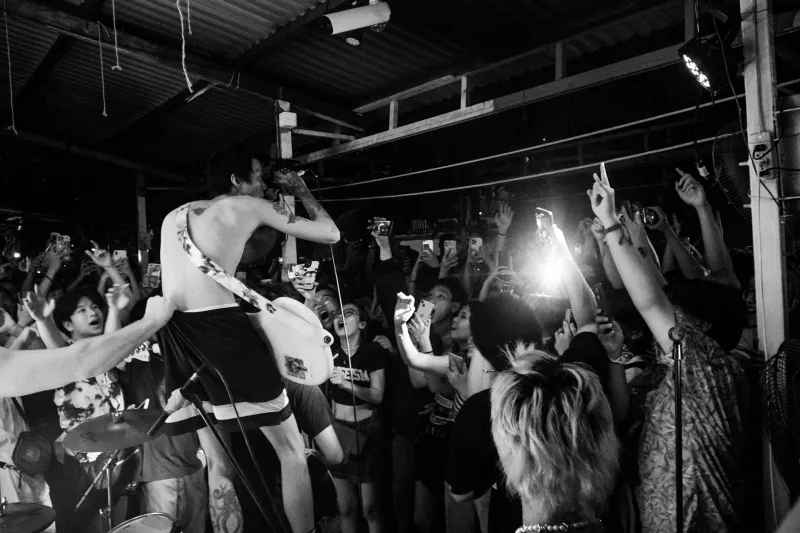
Before Van Halen was a band with a record deal, they were a band that played everywhere. And we mean that literally. The backyard party circuit in the Pasadena area during the early-to-mid '70s was a genuine local institution — neighborhood gatherings where a band could set up in someone's yard, run an extension cord out to a power strip, and play for a few hundred people who were mostly there for the beer and the vibe.
For the Van Halen brothers and their rotating cast of bandmates (the lineup that would eventually become Van Halen went through several name changes and personnel shifts before solidifying), these gigs were the equivalent of a residency. They played the same crowd week after week, which meant they had to keep expanding their setlist, keep tightening their sound, and keep finding ways to hold attention.
This is where the showmanship got built. Roth, who joined the band in 1974, understood immediately that a backyard party demanded a different kind of energy than a seated concert hall. You had to earn the room. Every single time.
Gazzarri's, the Starwood, and the Club Education
As the band developed, they moved into the club circuit that connected Pasadena to the broader LA scene. Venues like Gazzarri's on the Sunset Strip and the Starwood in West Hollywood became important proving grounds — places where industry people occasionally wandered in and where the competition from other hungry bands was fierce.
The Starwood, in particular, has a special place in Van Halen mythology. It was there, in the mid-'70s, that Gene Simmons of KISS caught the band and was impressed enough to fund a demo recording session. That demo didn't lead directly to a deal, but it validated something the band already suspected: what they were doing was different enough to get attention.
Local scene historians who followed the SoCal club circuit during this period note that Van Halen stood out not just for Eddie's playing — which was already in a category of its own — but for the band's collective tightness. Alex Van Halen's drumming was a particular conversation starter. He hit hard, kept impeccable time, and had a groove that translated even in rooms with terrible acoustics.
The Sound of Southern California
It's worth asking what SoCal specifically gave Van Halen that they couldn't have gotten somewhere else. Part of the answer is sonic. The Southern California rock scene of the '70s had a particular relationship with melody — even the heavy stuff had hooks, and the influence of the sunshine pop and soft rock that had come out of LA in the previous decade was still in the air.
Van Halen absorbed that. Their hard rock had a brightness to it, a melodic accessibility that separated it from the darker, more European-influenced metal coming out of the UK. Songs like "Dance the Night Away" and "Beautiful Girls" were essentially pop songs dressed in a hard rock wardrobe — and that combination was very SoCal.
The climate didn't hurt either. There's something about growing up in a place where you can realistically play an outdoor show in February that shapes how you think about music as a communal experience. Van Halen's energy always felt outdoor-ready, even in arenas.
The People Who Were There
Talk to anyone who caught Van Halen on the Pasadena backyard circuit or at those early club shows, and you'll hear a consistent version of the same story: we knew. We knew this wasn't a normal local band. We knew something was happening.
Fans who were teenagers in the San Gabriel Valley in the mid-'70s describe the experience of seeing Eddie play for the first time as genuinely disorienting — like watching someone do something you'd never seen a human being do before. The two-handed tapping technique that would later make "Eruption" famous was already showing up in live sets years before the debut album.
These early witnesses became the band's first real fan base — people who had a personal, pre-fame connection to Van Halen that gave their eventual national success a particular local pride. When the debut album dropped in 1978 and the whole country started catching up, Pasadena already had a head start.
Roots That Ran Deep
Van Halen never really left their SoCal identity behind, even as they became one of the biggest bands in the world. The energy of those backyard parties — the need to earn the room, to deliver something people would talk about the next day — stayed baked into their live approach throughout their career.
And the local scene that shaped them? It kept producing. The network of venues, promoters, and fellow musicians that surrounded Van Halen in those early years was part of a broader Southern California rock ecosystem that would continue generating major acts through the '80s and beyond.
But Van Halen got there first. And they got there because Pasadena gave them the space to become themselves before the world was watching.