Four Notes That Rewired Rock: The Story Behind Eddie's Most Copied Riff
There's a particular moment that a lot of Van Halen fans can pinpoint with almost uncomfortable precision. It's not the first time they heard the tapping cascade of 'Eruption.' It's not the synth intro to 'Jump.' It's the moment a needle dropped — or a cassette clicked — and that descending Am-G-F-G figure from Ain't Talkin' 'Bout Love crawled out of the speakers and rewired something in their brain. Simple. Brutal. Completely unforgettable.
If you've ever wondered why that riff hits different after nearly five decades, you're not alone. The answer lives somewhere in the intersection of Eddie Van Halen's gear, his instincts, and a recording philosophy that the band basically invented on the fly.
The Riff Itself: Deceptively Simple, Structurally Brilliant
Let's get one thing straight: on paper, the main riff to Ain't Talkin' 'Bout Love is not complicated. Any intermediate guitarist can learn the basic shape in an afternoon. It's an Am pentatonic-adjacent figure that moves down the neck with a kind of loping, predatory rhythm. So why does it sound so massive?
Part of the answer is timing. Eddie's attack on that riff isn't metronomically perfect — it swings in a way that most rock guitarists of the era weren't doing. There's a slight push-and-pull against the beat that makes it feel alive, almost like it's breathing. That rhythmic looseness was a signature Eddie trait, and it's something that gets lost when cover bands try to replicate it note-for-note. They get the pitches right and lose the personality entirely.
The other part of the answer is what Eddie was playing through.
The Gear Behind the Growl
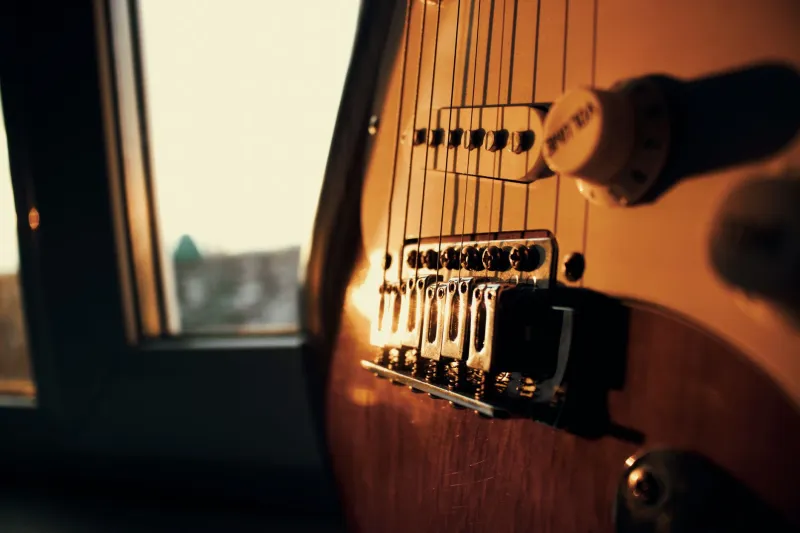
By 1977, when the band was cutting their debut at Sunset Sound in Hollywood, Eddie had already spent years building what would become one of the most talked-about guitar rigs in rock history. His homemade 'Frankenstrat' — a hybrid Stratocaster body loaded with a PAF-style humbucker — was central to the sound, but the amp situation was equally important.
Eddie was running a modified Marshall plexi through a Variac, a voltage transformer that let him run the amp at lower voltage and push it into a compressed, harmonically rich overdrive at manageable stage volumes. The result was a tone that was simultaneously tight and warm — not the scooped, sterile high-gain sound that would dominate the '80s, but something with actual body to it.
For Ain't Talkin' 'Bout Love specifically, that tone sits in a register that complements Dave Lee Roth's vocal range almost perfectly. The midrange presence of Eddie's rig cuts through without burying the vocals, which was a deliberate — if intuitively arrived at — studio decision. Producer Ted Templeman has talked about how little time the band spent overthinking arrangements. They played, he recorded, and what you hear on the record is largely what they played in the room.
A Gateway Drug for a Generation
Ask anyone who got into hard rock between 1978 and 1982, and a huge percentage of them will name that debut Van Halen album as the entry point. And within that album, Ain't Talkin' 'Bout Love was often the track that hooked them first — before 'Eruption,' before 'Runnin' With the Devil,' before anything else.
Why? Because it didn't require any context. You didn't need to know who Eddie Van Halen was or what two-handed tapping meant. You just needed ears. That riff communicated everything about the band's attitude in about four seconds: dangerous, confident, and deeply, deeply cool.
Guitarists who were teenagers in the late '70s talk about hearing it on the radio and immediately needing to figure out how it was made. Guitar teachers across the country started getting requests for it. Music stores started selling more Strat-style guitars because kids wanted to look like they could play it. The ripple effects were enormous and largely invisible — the kind of cultural influence that doesn't show up in sales charts but absolutely shows up in how rock guitar developed over the following decade.
The Tuning Secret That Nobody Talked About
Here's something that casual fans often miss: Eddie frequently used non-standard tuning approaches that contributed to the unique resonance of his recorded work. While Ain't Talkin' 'Bout Love isn't as dramatically altered as some later tracks, Eddie's tendency to tune slightly flat of standard pitch — sometimes as much as a half-step or more — gave his open strings a different harmonic relationship with fretted notes. That subtle detuning creates a slight beating between notes that adds warmth and complexity, especially on sustained chords.
For a riff built around open-string voicings and quick position shifts, that harmonic richness is the difference between a guitar part that sounds like a guitar and one that sounds like a force of nature.
Why It Still Matters
Decades on, that riff hasn't aged. You hear it in car commercials. You hear it at baseball games. You hear it cranked from garage windows in neighborhoods across America on warm Saturday afternoons. It became the kind of cultural furniture that people forget was ever invented — it just seems like it's always been there.
But it wasn't always there. Someone made it. A kid from Pasadena with a homemade guitar and a modified amp sat in a room and found those four notes, and the world of rock guitar quietly shifted on its axis.
That's what Eddie did. Not just on 'Eruption,' not just in the flashy moments — but in the riffs that seemed too simple to be genius until you tried to replace them with something else and realized you couldn't.